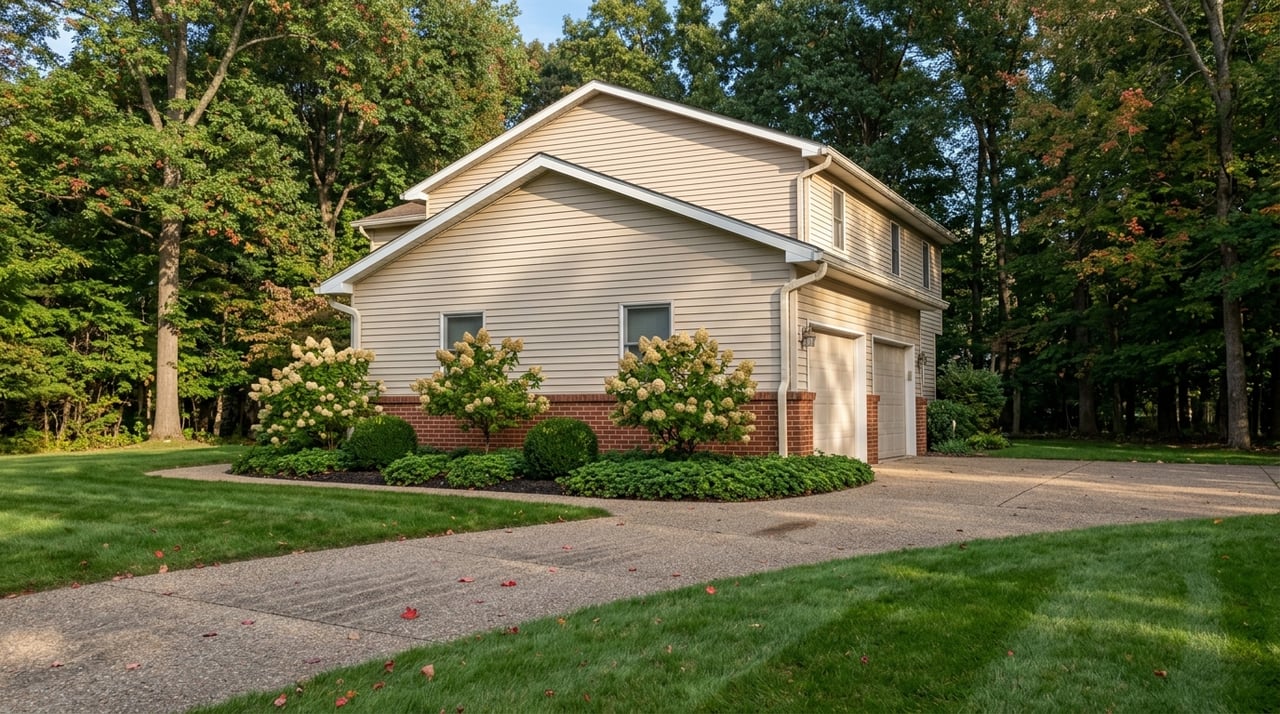
Type "Boonton" into a home search and you'll get results from two separate municipalities. Boonton is a walkable historic borough with Victorian storefronts along Main Street, public water, and public sewer. Boonton Township is the larger, more rural community next door, governed by its own committee, served in large part by private wells and septic systems, and zoned in places to a different school district entirely. They share a name, a border, and part of the Rockaway River. They do not share an infrastructure system, a tax base, or, as it turns out, a price tag.
Here's the part that surprises most buyers who assume the walkable downtown commands the premium: it doesn't.
The Price Reversal Nobody Expects
In the twelve months ending this summer, with the most recent recorded closing on July 31, 2026, Boonton the borough has a median sale price of $750,000, up 13% year over year, with homes moving in an average of 35 days and 160 sales recorded in that span. That's a healthy, competitive market for a town built on quarter-acre lots and short commutes to the train station.
Boonton Township is telling a different story. A snapshot of the township's active inventory in early June 2026 showed 14 homes listed, with the average price landing between $1,065,836 and $1,072,979 depending on which brokerage feed you pull. A separate snapshot from late May 2026 recorded a median list price of $1,325,000 across 11 active listings. Even the more conservative estimate from a residential valuation model, dated to mid-April 2026, placed the township's median home price at $802,876, still well above the borough's median sale figure.
None of these numbers are measuring the exact same thing. List price isn't sale price, and a snapshot of 11 or 14 active listings isn't a full-year transaction count the way the borough's 160-sale figure is. But the sources, taken across April, May, and June of 2026, all land in the same place: the township with no public sewer connection and no municipal water main is currently the more expensive place to buy.
If you've been assuming that "Boonton" search results represent one market with a single price ceiling, the data says otherwise. The premium sits in the township, not the borough.
Why the Well-and-Septic Town Costs More
The mechanism isn't mysterious once you see what's actually being built there. Boonton Township's newer inventory skews toward larger parcels and custom construction rather than resale colonials on small lots. The Stonehenge development has been releasing individual building lots with wells and septic systems already installed or in progress, several of them advertised with unobstructed New York City views. A few streets over, the Bristol Ridge enclave has done the same, marketing itself explicitly as an enclave of luxury homes rather than a subdivision of starter houses, with some of its lots also listed for their city views. On the higher end, a custom-built home in the Hawk Hill area recently listed on 2.24 private acres with four bedrooms and seven bathrooms, a scale of house that simply doesn't exist on the borough's smaller lots.
Lot size is doing real work here. A township parcel built on three quarters of an acre or more, with a private well and a septic field instead of a metered municipal connection, is a fundamentally different product than a borough lot a fraction of that size sitting on public infrastructure. You're not comparing two versions of the same house. You're comparing two different building types that happen to share a mailing town.
There's also a school-zoning wrinkle that surprises people who haven't shopped this specific corner of Morris County: several Boonton Township parcels, including some of the Stonehenge lots and at least one recent three-quarter-acre custom rebuild with a heated pool and Ramapo Mountain views, are zoned for the Mountain Lakes School District rather than Boonton Township's own schools, because township boundaries and school-district boundaries don't line up perfectly here. It's worth confirming which district applies to a specific parcel before you fall in love with a listing photo, since the answer changes street by street rather than town by town.
The Paperwork That Comes With the Lower Utility Bill
A private well and a septic field don't show up on your monthly bill, but they show up somewhere else: the closing table.
New Jersey's Private Well Testing Act requires that untreated well water be tested for up to 43 separate contaminant parameters before a title can close, with results reviewed and signed off by both buyer and seller. That list isn't identical everywhere in the state. Morris County is one of the specific counties where the New Jersey Department of Environmental Protection requires uranium testing as part of the standard panel, a requirement tied to the geology of this part of the state rather than something you'll find on every well test in New Jersey. If you're used to shopping towns with public water, this is a step that simply doesn't exist in your last transaction.
Septic works differently, and it's easy to get the rule wrong in either direction. Septic Finder NJ explains that there is no single statewide law in New Jersey requiring a septic inspection before every home sale. Some municipalities have their own ordinances setting a window, but where one applies, it's set locally rather than by the state. What is consistent statewide is the inspection protocol itself: the New Jersey Department of Environmental Protection's technical guidance for onsite wastewater system inspections says that an inspection performed as part of a property transfer has to follow its protocol covering the tank, baffles, distribution box, and drain field.
Morris County adds one more layer worth knowing about if you're looking at property near either of the two reservoirs bordering Boonton Township. Split Rock Reservoir, reached from the township side via Split Rock Road, and the Boonton Reservoir just south of it both supply drinking water to Jersey City. According to ATS Environmental, Morris County health departments have historically applied stricter septic enforcement in watershed protection areas near lakes and reservoirs, sometimes requiring enhanced treatment systems rather than a conventional tank and field. If a property you're considering sits inside one of those zones, that's a question worth asking your inspector and the local health department directly, before you're deep into attorney review.
What This Means If You're Comparing the Two Towns
If your search has been treating "Boonton" as one market, here's the recalibration worth making before you write an offer:
- Don't assume walkable equals expensive. In this pairing, the opposite is currently true. The borough's downtown convenience comes at a lower median price than the township's larger lots and private infrastructure.
- Budget for the well test as a real line item, not a formality. Between the standard 43-parameter panel and the Morris County uranium requirement, this is a cost and a timeline step that a public-water purchase simply skips.
- Ask about septic history and watershed zoning early. Because New Jersey's inspection rule is set locally rather than statewide, and because Split Rock and Boonton Reservoir watershed rules can mean a stricter system requirement, this is a question for your inspector and the seller's disclosure, not an assumption.
- Confirm the school district by parcel, not by town name. A Boonton Township address doesn't automatically mean Boonton Township schools.
A Few Straight Answers
Are Boonton and Boonton Township the same place? No. They're two separate New Jersey municipalities that share a border and a name but have their own governments, tax rates, and infrastructure.
Do all homes in Boonton Township use wells and septic systems? Not all, but a substantial share of the township's newer and larger-lot inventory does, including recent releases in the Stonehenge and Bristol Ridge developments.
Who pays for the well water test? Sellers commonly cover the test, and the law requires it to happen before closing regardless of who initiates it.
Is a septic inspection legally required to sell in Boonton Township? There's no statewide mandate in New Jersey. Whether one is required here depends on local ordinance, so this is a question to confirm directly with the township or county health department rather than assume either way.
If you're trying to figure out which side of this border actually fits your budget, your commute, and your tolerance for well maintenance, that's exactly the kind of comparison worth walking through with someone who knows both towns block by block. Anne Henderson works this part of Morris County every day and can help you sort out what a specific address actually means before you fall for a listing photo. Request a complimentary home valuation to start the conversation.
This article is general information, not legal, tax or financial advice. Consult a qualified professional about your situation.